


Why your log home went grey — and what stripping it actually involves
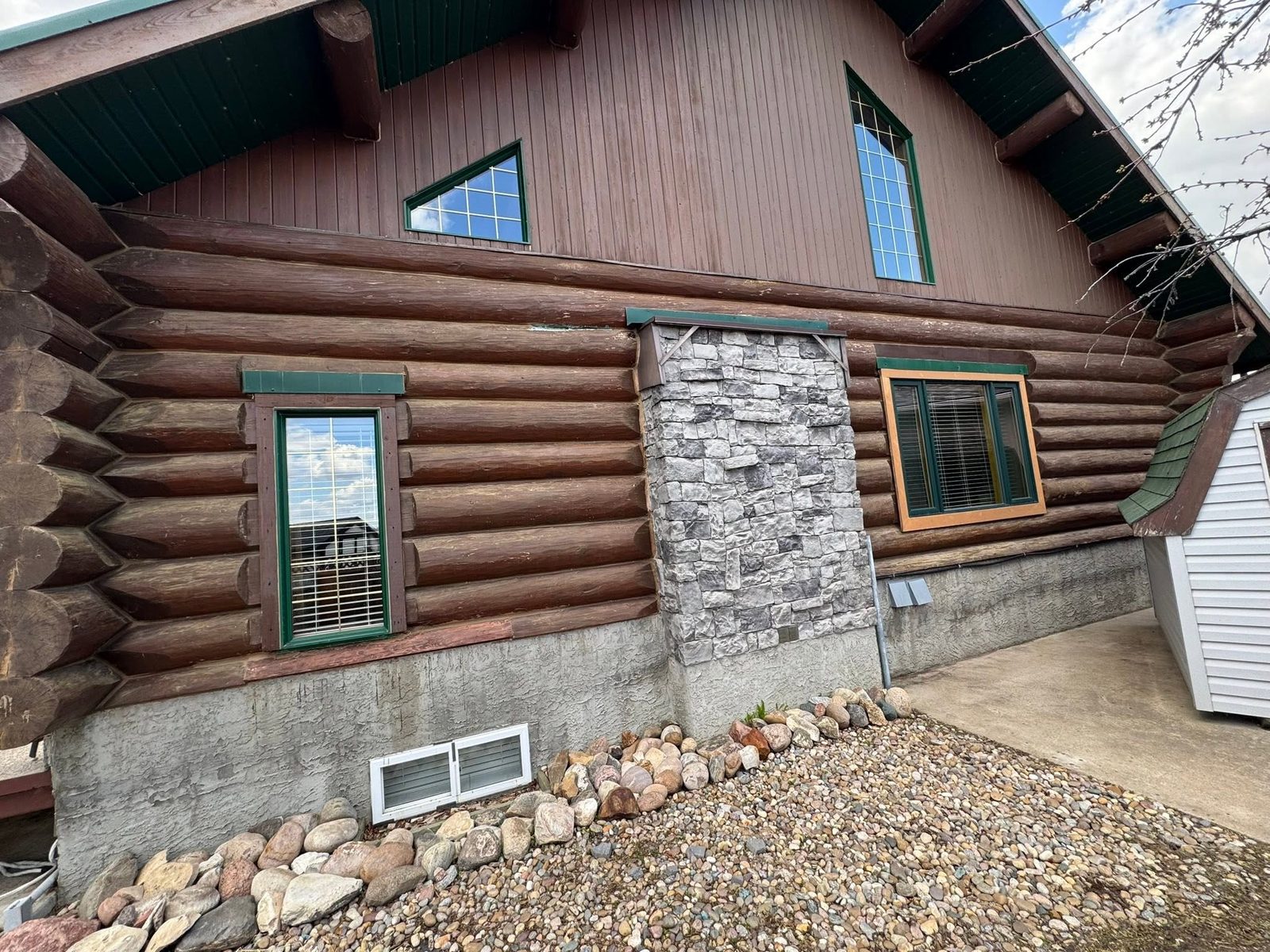
Almost every log home owner we talk to thinks the grey is dirt. It is not. It is the wood itself, and understanding that changes what you should do about it.
What grey actually is
Sunlight breaks down lignin — the natural polymer that binds wood fibres together and gives timber its colour. Once the lignin in the top layer degrades, what is left is loose cellulose fibre, which weathers to silver-grey and no longer holds a finish.
That is why washing a grey log home disappoints. You can remove the dirt sitting on top and the wood underneath is still grey, because the grey is the surface layer of the wood, not something on it.
If the grey were dirt, a pressure washer would fix it. The fact that it does not is the whole reason blasting exists as a trade.
Why the stain failed before the wood did
Most log home finishes fail from underneath. UV degrades the wood immediately below the film, the degraded fibres let go, and the coating comes off still attached to a layer of dead wood. That is why failed stain sheets and flakes rather than simply fading.
It also means re-coating over a failing finish buys you a season, maybe two. The new stain is bonded to the same loose fibres that let the old one go.
Sanding versus blasting
Sanding a log wall sounds reasonable until you try it. A disc rides the crown of every log and skips the cove between courses — and on a hand-hewn or character wall it never touches the chinking line at all. You end up with bright crowns, grey hollows, and stain that lands blotchy over the sanded-through patches.
Media follows the profile. It reaches the cove, the corner notches, the underside of the log and around every window buck at the same rate as the flat, so the take-off is even and the new stain lands uniform.
The part that goes wrong
Wood has soft spring growth between the harder summer grain. Wrong media, wrong pressure, and the soft bands cut faster than the hard ones. What you get is a corrugated, furry surface that looks eroded, drinks stain unevenly, and cannot be put back.
It happens faster here than most owners expect. Southeast Alberta gets more annual sunshine than almost anywhere in Canada, and on an exposed wall above Elkwater Lake or on open ground near Seven Persons there is nothing to slow it down.
What the day looks like
- Mask and protect. Windows, doors, decks, mechanicals and anything planted.
- Test patch. A small area, checked for take-off rate and grain condition, pressure adjusted.
- Strip. Working top down, wall by wall, so nothing lands on finished work.
- Clean up. Spent media collected and removed.
- Hand back a dry, open surface ready for the stain crew.
Then seal it, and reasonably soon
Bare stripped logs are open and thirsty. In southeast Alberta sun they will begin greying again within weeks if they are left standing. Have the finish lined up before the blast starts, not after.
If you are in Cypress Hills or Elkwater, we are forty minutes away — which is the reason we can quote a cabin that is not worth a Calgary crew's travel.
Talk it through with Matt.
Call 403-702-4435 or text a photo of the job for a straight answer.
Fastest way to a number: text a photo of what needs blasting to 403-702-4435.
Keep reading.
How often does a log home need re-staining in southern Alberta?
Our sun and wind are harder on a log wall than most of Canada. Here is a realistic cycle by elevation, and the signs that say do it now.
Read it
Chinking: what it does and when it has to be replaced
Chinking is the seal between your logs and the weather. Here is how to tell whether yours is tired, and how it interacts with a blast.
Read it
Choosing a stain for a freshly blasted log home
Bare logs will take almost anything, which is exactly the problem. Film vs penetrating, clear vs pigmented, and what our sun does to each.
Read it